The escalation of tensions in the Middle East, and the resulting disruption to shipping in the Strait of Hormuz, have triggered a sharp surge in global oil and chemical prices, creating ripple effects across energy, agricultural, and industrial supply chains.
U.S. consumer prices, particularly for gasoline, have risen sharply due to ongoing Middle East tensions, with the average price per gallon reaching $4.10 by early April 2026—a 37% increase since the U.S.-Israeli strike on Iran on February 28. The near-closure of the Strait of Hormuz, which handles about 20% of global oil shipments, has disrupted crude supplies, forcing refiners to seek costlier alternatives and driving Brent and WTI futures above $110 and $112 per barrel, respectively. This energy shock is cascading through the economy: import prices in February saw their largest jump since 2022 (up 1.3% monthly, 1.3% annually), core import prices surged 3.0% year-over-year, and producer costs for capital goods hit a record high. As a result, inflation expectations have become unanchored, with the public doubting the Fed’s 2% target, while policy makers are divided on rate cuts—market pricing now implies less than a 10% chance of a 2026 rate reduction.
The impact extends beyond this.
Energy and chemical price surge in China
In March 2026, China’s Bulk Commodity Price Index rose 4% month-on-month and 14.5% year-on-year, driven largely by imported inflation from higher international crude oil prices. Domestic energy and chemical price indexes jumped 16.5% and 21.8%, respectively. Methanol and ethylene glycol (MEG) saw particularly steep gains—up 30.4% and 29.3% month-on-month. MEG prices surged over 40% (up RMB 1,602/ton) due to three compounding factors: high import dependence (28% of China’s MEG is imported, over 60% of which comes from the Middle East), concentrated supply sources, and the single shipping lane through Hormuz.
Global chemical and agricultural cost transmission
The conflict has reshaped global chemical supply chains. BASF issued its fifth price hike notice in a month for amines and intermediates, citing higher raw material, energy, and logistics costs. Meanwhile, the UN Food and Agriculture Organization reported that global food prices rose 2.4% in March, as higher energy costs increased agricultural production and transport expenses. Vegetable oil and sugar prices led gains, up 5.1% and 7.2% respectively.
Downstream impact on agriculture
Farm chemical prices are rising in North America. Glyphosate prices are expected to jump by about USD 1 per liter, while glufosinate shipments face 1–2 month delays at the Port of Vancouver. Key inputs such as yellow phosphate (for glyphosate) and natural gas are in short supply. In South Korea, feed prices have risen 3% since November 2025, with soybean meal up 8.3% and corn 3.4%. Fertilizer prices are also under pressure—natural gas futures soared 62.4% month-on-month in March, and the global nitrogen fertilizer index rose 35.2%. Korea expects stable fertilizer supply only through July, with price increases inevitable from August onward.
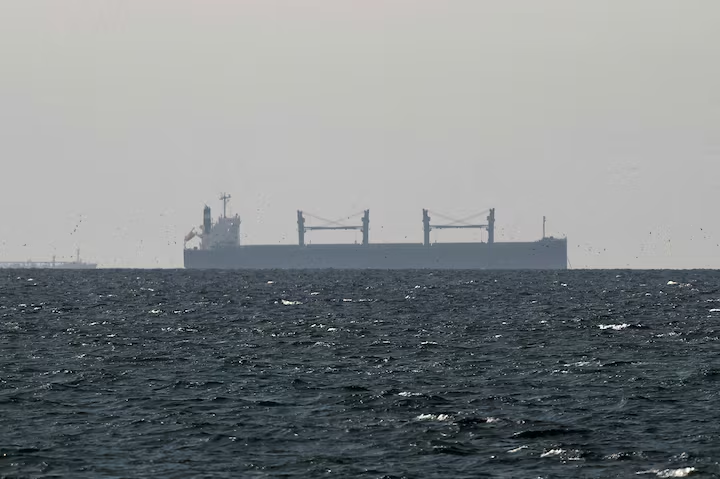
The strategic importance of the Strait of Hormuz lies in its status as a critical choke point for global energy supplies; were the strait to be blocked, it would directly trigger spiraling oil prices and jeopardize the stability of the global economy. According to reports, Iran has vowed to take action against the United States and Israel to permanently alter the status quo of the strait; currently, the Islamic Revolutionary Guard Corps has completed its combat preparations, aiming to forcibly establish a "new order" in the Persian Gulf region. The Iranian Parliament is moving forward with legislative and security frameworks designed to assert its jurisdiction over the strait; proposed measures include banning the passage of vessels from the United States, Israel, and nations imposing sanctions on Iran, as well as making the receipt of reparations for past conflicts a prerequisite for reopening the strait. Meanwhile, the United States under the Trump administration has issued threats of military strikes—such as bombing Iranian power plants and bridges—and has called for an international naval escort operation, although key allies such as Germany and Japan have expressed hesitation regarding such a move.
On April 5, the Organization of the Petroleum Exporting Countries (OPEC) issued a statement announcing that eight major oil-producing nations—including Saudi Arabia, Russia, Iraq, the United Arab Emirates, Kuwait, Kazakhstan, Algeria, and Oman—have decided to increase their daily crude oil production by 206,000 barrels in May.